The PACFAIE Review · Journal on AI ethics, policy & governance

Perspectives on AI ethics and governance in Africa

Volume 1, Issue 1 · 2026

A peer-reviewed, interdisciplinary journal advancing rigorous scholarship and policy on AI governance across the continent.

Open to accepted Summer School participants
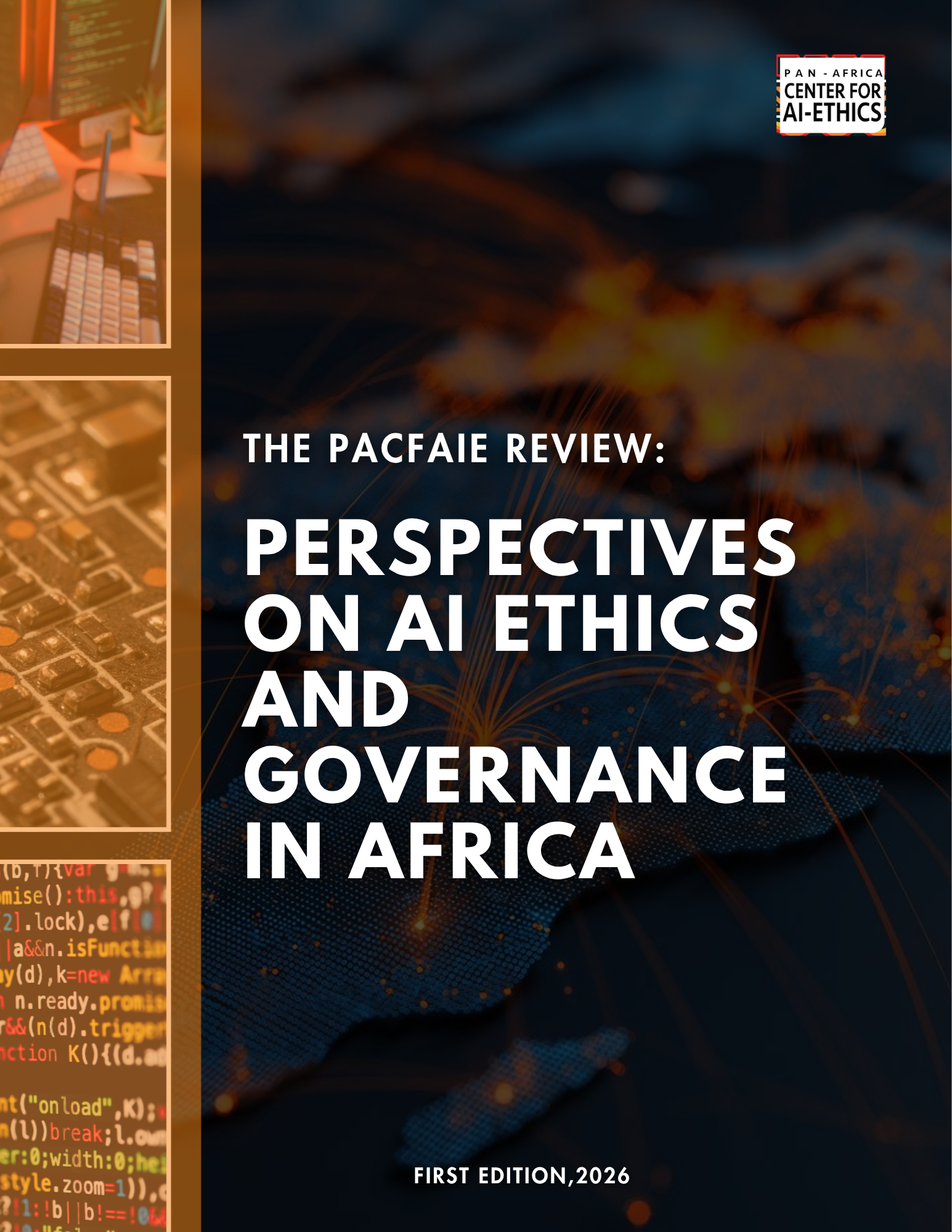
The PACFAIE Review, Volume 1 Issue 1 cover

About this issue

Africa stands at a critical juncture. Artificial intelligence presents unprecedented opportunities for development, innovation, and public-service delivery — across healthcare, education, agriculture, and financial inclusion — while raising complex ethical, legal, regulatory, and governance challenges that demand context-specific responses.

The inaugural issue of the PACFAIE Journal on AI Ethics, Policy and Governance establishes a premier interdisciplinary avenue for rigorous scholarship and critical discourse on AI governance in Africa. This first volume explores fifteen emerging themes at the intersection of AI, ethics, law, public policy, human rights, innovation governance, and digital sovereignty — aiming to inform evidence-based policymaking, strengthen regional cooperation, and promote African leadership in shaping the future of global AI governance.

15 emerging themes
Double-blind peer review
Diamond open access

Submissions are by acceptance only

Manuscripts are accepted only from participants admitted to the 2026 AI Ethics Summer School.

Apply to the Summer School

Call for papers

Theme: Emerging frontiers in artificial intelligence governance — African perspectives on ethics, policy and regulation.

AI governance sandboxes Algorithmic accountability AGI governance Generative AI Indigenous knowledge systems Neurotechnology governance AI safety Responsible AI certification and more

Policy & regulatory analyses

4,000–8,000 words

Case notes & legislative reviews

2,500–5,000 words

Practitioner perspectives

2,000–4,000 words

Book reviews

1,000–2,000 words

All submissions must include an abstract (150–250 words), 4–6 keywords, and follow APA 7th Edition.

Author & publication guidelines

Format

Original, unpublished work only. Microsoft Word (.docx), Times New Roman 12-point, 1.5 line spacing, APA 7th Edition referencing.

Manuscript structure

Title page, abstract, keywords, introduction, literature review, methodology (where applicable), findings, discussion, conclusion, recommendations, references.

Peer review

All submissions undergo double-blind peer review. Maximum similarity threshold: 15% (excluding references and properly attributed quotations).

AI disclosure

Authors must disclose any use of AI tools in research, drafting, editing, coding, or analysis, and remain responsible for accuracy and originality.

Editorial board & advisors

Announced soon
Announced soon
Announced soon
Announced soon
Announced soon

Editorial team & committee

Announced soon
Announced soon
Announced soon
Announced soon

Peer reviewers

Reviewers announced soon

Join our peer reviewers

We welcome researchers and practitioners with relevant expertise to apply to our reviewer pool.

Apply to be a reviewer

Open access & copyright

The PACFAIE Journal operates under a Diamond Open Access model: readers access all content free of charge, and authors publish at no cost. Authors retain copyright and grant the Journal a non-exclusive licence to publish and distribute their work.

Free to read

All content open to everyone, no paywall.

Authors retain copyright

You keep ownership; we publish under licence.

CC BY 4.0

Recommended Creative Commons licence.

Accepted to the Summer School?

Submit your manuscript for Volume 1, Issue 1.

Submit your manuscript
Pan-Africa Center for AI Ethics

The PACFAIE Review — perspectives on AI ethics and governance in Africa.

Follow

© 2026 Pan-Africa Center for AI Ethics. All rights reserved.
Pan-Africa Center For AI Ethics - Pacfaie
Privacy Overview

This website uses cookies so that we can provide you with the best user experience possible. Cookie information is stored in your browser and performs functions such as recognising you when you return to our website and helping our team to understand which sections of the website you find most interesting and useful.